






Samsung Faces $15 Million Fine in South Korea Over Galaxy S21 and S22 Gaming Performance
Samsung disagrees with the decision and has indicated that it plans to challenge the regulator's findings through legal procedures.

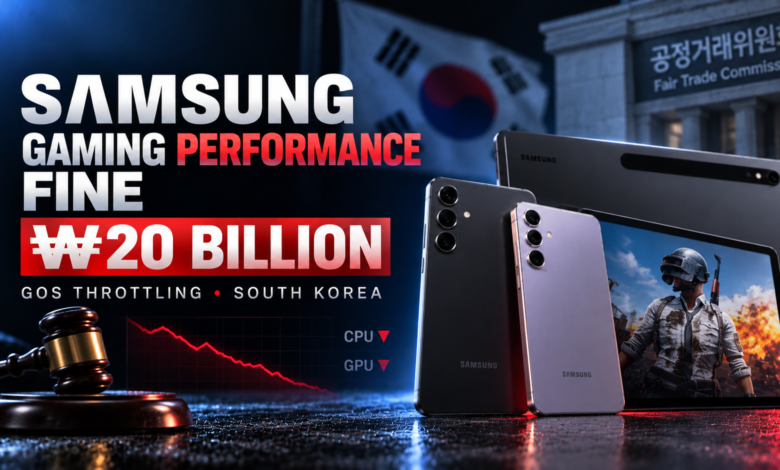
Samsung is facing a penalty of approximately $15 million after South Korean regulators determined that the company misled consumers about the gaming performance of several Galaxy devices. The country’s Fair Trade Commission says Samsung promoted the Galaxy S21 series, Galaxy S22 series and Galaxy Tab S8 lineup for their gaming capabilities without clearly disclosing that a built-in service could restrict their maximum performance as soon as certain demanding games were launched.
The decision centres on Samsung’s Game Optimizing Service (GOS), a system designed to manage gaming performance and heat. According to the regulator, the service applied preset CPU and GPU performance limits to selected games regardless of the device’s temperature or operating conditions.
Samsung disagrees with the decision and has indicated that it plans to challenge the regulator’s findings through legal procedures.
Samsung Faces a Fine of Around $15 Million
South Korea’s Fair Trade Commission has decided to impose a corrective order and a provisional fine of approximately 20.1 billion South Korean won, equivalent to around $15.1 million, on Samsung Electronics.
The decision concerns advertising for the Galaxy S21 and S22 smartphone series and the Galaxy Tab S8 tablet series. Samsung promoted these devices between January 2021 and March 2022, highlighting their processing power, responsive displays and gaming capabilities.
According to the regulator, Samsung’s advertisements created the impression that consumers could enjoy high-performance mobile gaming without disclosing an important limitation affecting certain demanding games.
The commission concluded that omitting this information could influence purchasing decisions, particularly because gaming performance was an important consideration for customers buying premium smartphones and tablets.
The penalty is accompanied by a corrective order. However, Samsung has disputed the findings and says it intends to present its position through legal proceedings.
What Is Samsung’s Game Optimizing Service?
The controversy revolves around Samsung’s Game Optimizing Service, commonly known as GOS.
GOS is a system designed to manage smartphone performance during gaming. Mobile games can place considerable demands on a device’s processor and graphics hardware, potentially generating heat and increasing power consumption.
To manage these conditions, smartphones may adjust CPU and GPU speeds according to temperature, workload and other operating factors.
However, the South Korean regulator distinguished between GOS’s general thermal management behaviour and its game-specific restrictions.

According to the commission, the general policy adjusted performance depending on the device’s condition, while certain game-specific policies imposed predetermined performance limits immediately after particular demanding games were launched.
This meant that the maximum CPU and GPU operating speeds could be restricted regardless of whether the device had actually reached a temperature that required such intervention.
The regulator argued that this limitation was important information for consumers because Samsung was simultaneously promoting the devices’ gaming capabilities.
CPU and GPU Performance Could Drop to Around 30%
One of the most significant findings concerns the extent of the reported restrictions.
According to the commission, GOS could reduce the maximum operating speeds of a device’s CPU and GPU to approximately 30% of their original maximum levels in some circumstances.
The regulator cited the Galaxy S22 series as an example. When running PUBG: New State, the reported CPU clock-speed ceiling was reduced from 2.99GHz to 0.94GHz, while the GPU limit fell from 818MHz to 220MHz.
These figures represent the regulator’s findings about the preset operating limits, rather than a claim that every game would run at exactly 30% of its normal performance.
The commission also identified the number of games subject to these restrictions across the affected devices.
According to its findings, the restrictions applied to 82 games on the Galaxy S21 series, 47 games on the Galaxy S22 series and eight games on the Galaxy Tab S8 series.
The regulator said these restrictions could cause stuttering, delays, freezes and reduced graphics quality when games required more processing power than the imposed limits allowed.
For users who purchased premium devices expecting strong gaming performance, these limitations were a significant part of the regulator’s case.
Why South Korean Regulators Considered the Advertising Misleading
Samsung’s marketing highlighted the performance of its devices and their suitability for demanding mobile games.
The company’s promotional material included claims about fast processors, responsive touch controls, smooth screen transitions and an improved gaming experience.
According to the commission, these claims were made without clearly informing consumers that selected games could trigger immediate performance restrictions.
The regulator argued that gaming performance was an important purchasing factor during the period in question. High-end mobile games were becoming more demanding, while premium smartphones were increasingly marketed as powerful gaming devices.
Consumers could therefore reasonably consider advertised gaming performance when deciding which smartphone or tablet to purchase.
The commission concluded that failing to disclose the preset restrictions could create a misleading impression of the devices’ actual gaming capabilities.
Its decision was based on South Korea’s Act on Fair Labeling and Advertising, which prohibits deceptive advertising practices.
The case highlights an important distinction between having a performance-management feature and failing to explain how that feature affects a product’s advertised capabilities.
Thermal management can be necessary in modern smartphones, but regulators argued that consumers should have been informed about limitations that materially affected the performance being promoted.
Samsung Updated GOS in March 2022
The controversy originally attracted attention in 2022, when Galaxy users raised concerns about gaming performance and the behaviour of GOS.
Samsung subsequently released a software update in March 2022 that allowed users to bypass the performance restrictions at issue.
The update followed complaints from users who reported stuttering, reduced graphics quality and other performance problems when playing demanding games.
Samsung has argued that GOS was intended to optimise the gaming experience and help devices maintain stable performance during extended gaming sessions.
The company maintains that managing heat and maintaining sustained performance are important considerations when running demanding applications on compact mobile devices.
Samsung also pointed to the software changes introduced in 2022 when responding to the regulator’s decision.
However, the commission’s case focused on the advertising practices used when the affected devices were being marketed. The subsequent software update did not eliminate the regulator’s concern that consumers had not been properly informed about the restrictions at the time of purchase.
Samsung Plans to Challenge the Decision
Samsung has strongly disputed the regulator’s findings.
The company says GOS was designed to improve the overall gaming experience and support stable gameplay over extended periods. Samsung argues that peak CPU and GPU clock speeds do not, by themselves, determine how smoothly a game performs.
According to the company’s position, managing performance and heat can help prevent excessive temperatures and maintain a more consistent experience during long gaming sessions.
Samsung has also questioned the decision because previous domestic and international legal disputes relating to GOS had already concluded or been withdrawn.
The company has indicated that it intends to defend its position through legal procedures after reviewing the regulator’s written decision.
This means the case may not be over. The announced penalty reflects the commission’s decision, while Samsung’s planned challenge could lead to further legal proceedings.
The outcome will determine whether the regulator’s findings and penalty remain in place.
Which Samsung Devices Are Affected?
The decision specifically concerns three product families:
- Galaxy S21 series: Samsung’s 2021 flagship smartphone lineup.
- Galaxy S22 series: The company’s 2022 flagship smartphones.
- Galaxy Tab S8 series: Samsung’s premium Android tablets released in 2022.
The regulator’s findings relate to the advertising of these devices during the period between January 2021 and March 2022.
The case does not mean that every Samsung smartphone is affected by the same restrictions. It also does not establish that Samsung’s current devices operate under identical game-specific policies.
Samsung introduced software changes in March 2022 to address the performance restrictions at the centre of the controversy.
Consumers using newer Galaxy devices should therefore avoid assuming that the historical findings automatically apply to their phones or tablets.
What This Means for Samsung and Smartphone Buyers
The case could have implications beyond the affected Galaxy devices.
Smartphone manufacturers regularly advertise processor speeds, display refresh rates, gaming capabilities and other performance-related features. However, real-world performance can depend on thermal management, software policies, power consumption and the demands of individual applications.
The South Korean regulator’s decision reinforces the importance of disclosing significant limitations when promoting a device’s performance.
For consumers, the case also illustrates why peak benchmark scores do not always tell the complete story. Sustained performance, thermal behaviour and software optimisation can be equally important when evaluating a smartphone for gaming.
For Samsung, the financial penalty is relatively small compared with the company’s overall business, but the case could affect consumer perceptions of its gaming-related marketing claims.
The legal challenge may also determine how regulators assess similar performance-management systems in the future.
Samsung’s GOS Controversy Returns to the Spotlight
Samsung’s dispute with South Korean regulators has brought renewed attention to the Galaxy S21 and S22 gaming performance controversy.
The Fair Trade Commission concluded that Samsung promoted the devices’ gaming capabilities without clearly disclosing preset performance restrictions affecting certain demanding games. It has consequently ordered corrective action and announced a provisional fine of approximately 20.1 billion won.
Samsung maintains that GOS was designed to manage heat and support stable gaming performance, and it plans to challenge the decision through legal procedures.
For now, the case remains a significant reminder that smartphone manufacturers must clearly communicate limitations that could affect consumers’ purchasing decisions. The final outcome will depend on the legal process and whether Samsung can successfully challenge the regulator’s findings.