





Samsung Galaxy S27 Gets BIS Certification in India Ahead of Expected 2027 Launch
The certification comes after the smartphone appeared in other databases, including China's 3C platform and the NBD database, revealing several possible specifications.

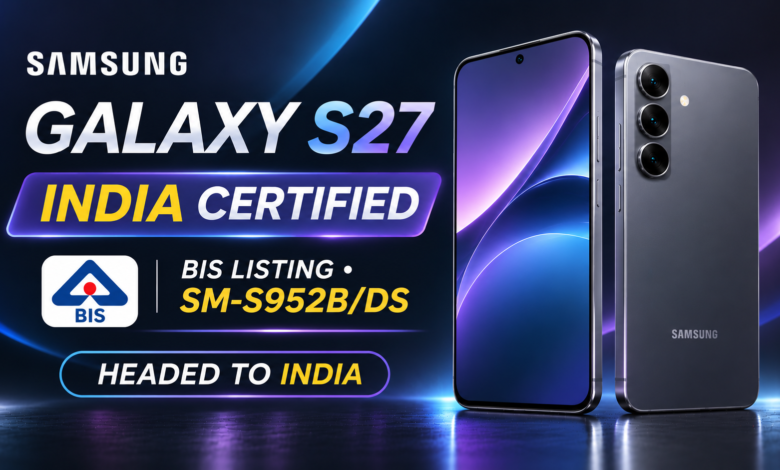
Samsung’s next-generation flagship smartphone is getting closer to its expected launch, and Indian buyers have a reason to be interested. The Samsung Galaxy S27 has reportedly received certification from India’s Bureau of Indian Standards (BIS), suggesting that the company is preparing to bring its upcoming flagship to the Indian market.
The device has appeared in the certification database with the model number SM-S952B/DS. Although the listing does not directly reveal the Galaxy S27 name or provide any hardware specifications, this model number has previously been associated with Samsung’s upcoming standard Galaxy S27.
The certification comes after the smartphone appeared in other databases, including China’s 3C platform and the NBD database, revealing several possible specifications.
Leaks suggest that the Galaxy S27 could feature a 6.3-inch AMOLED display, Samsung’s upcoming Exynos 2700 chipset, 12GB of RAM and 256GB of storage. The phone is also tipped to retain 25W wired charging, which would be disappointing for users expecting a significant charging upgrade.
Samsung Galaxy S27 Appears on India’s BIS Certification Database
The latest development comes from India’s Bureau of Indian Standards certification database.
A Samsung smartphone carrying the model number SM-S952B/DS has reportedly received BIS approval. This model number is believed to belong to the standard Galaxy S27.
BIS certification is an important regulatory requirement for electronic products entering the Indian market. When an upcoming smartphone appears in the database, it can indicate that the manufacturer is preparing the device for a regional release.
The listing does not explicitly mention the Galaxy S27 marketing name, nor does it reveal details about its display, processor, battery or cameras.
However, the model number matches the one previously spotted in other databases with specifications associated with Samsung’s next-generation compact flagship.
This makes the certification an encouraging sign for Indian consumers waiting for the Galaxy S27.
It is worth remembering that certification does not confirm an exact launch date. Samsung has yet to officially announce the smartphone or reveal its Indian availability.
Galaxy S27 Could Feature a 6.3-Inch AMOLED Display
Previous leaks from the NBD database have provided some information about the Galaxy S27’s expected hardware.

According to the listing, the standard Galaxy S27 could feature a 6.3-inch AMOLED display.
This would keep the phone in the compact flagship category, making it an option for users who prefer a relatively smaller smartphone without giving up premium hardware.
Samsung has consistently used its Dynamic AMOLED technology across the Galaxy S series, although the exact display specifications of the upcoming model have not been confirmed.
The refresh rate, resolution, peak brightness and other panel details remain unknown.
The Galaxy S26 already features a 6.3-inch 120Hz Dynamic AMOLED 2X display, so Samsung could retain a similar screen size for its successor while focusing on improvements elsewhere.
For now, the 6.3-inch panel should be treated as a leaked specification rather than an officially confirmed feature.
Exynos 2700 Chipset Expected to Power the Galaxy S27
One of the most important hardware details revealed by earlier leaks is the possible processor.
The standard Galaxy S27 is tipped to use Samsung’s upcoming Exynos 2700 chipset.
If accurate, this would make the Exynos 2700 a major part of Samsung’s next-generation flagship strategy.
The chipset is expected to succeed the Exynos 2600 used in the Indian version of the Galaxy S26. However, Samsung has not officially announced the Exynos 2700 or shared its performance specifications.
The NBD listing reportedly associates the Galaxy S27 with the Exynos 2700, 12GB of RAM and 256GB of internal storage.
There could also be regional differences in processor availability. Some reports suggest that Samsung may use Qualcomm’s Snapdragon 8 Elite Gen 6 in the US version of the standard Galaxy S27.
If Samsung follows this approach, the chipset offered to buyers could depend on the market.
However, the final processor configurations have not been confirmed, and Samsung could make changes before the official launch.
Galaxy S27 Could Retain 25W Wired Charging
Another detail that has surfaced through certification platforms is the phone’s charging speed.
The Galaxy S27 has previously appeared on China’s 3C certification database, with the listing indicating support for 25W wired charging.
This information was later supported by UL Solutions certification records covering multiple regional variants.
If the leaked details are accurate, the standard Galaxy S27 could retain the same charging speed as the Galaxy S26.
That would be disappointing for buyers expecting faster charging on Samsung’s next-generation flagship.
Many competing smartphones already offer considerably higher charging speeds, making 25W feel conservative for a premium device.
However, Samsung has historically taken a cautious approach to charging speeds across its standard Galaxy S models.
The battery capacity of the Galaxy S27 has not been confirmed. Its wireless charging capabilities and any potential changes to battery technology also remain unknown.
For now, the available certification information points towards 25W wired charging, but Samsung has not officially confirmed the specification.
Samsung Galaxy S27 Camera Could Get a Sony 50MP Main Sensor
The camera system could also receive an important change.
According to earlier rumours, Samsung may equip the Galaxy S27 with a 50MP primary camera using a Sony sensor.
This would represent a potential change from the Samsung ISOCELL sensor used in the previous generation.
The rest of the rear camera setup is tipped to remain familiar, with a 12MP ultra-wide camera and a 10MP telephoto camera.
A 12MP front-facing camera is also expected.
If these reports prove accurate, Samsung could retain much of the existing camera configuration while changing the primary sensor.
However, the use of a different sensor does not automatically guarantee better photographs. Image quality also depends on lens quality, image processing, software optimisation and computational photography.
The camera specifications remain unconfirmed, and Samsung has not revealed any official information about the Galaxy S27’s photography capabilities.
Samsung Galaxy S27 Specifications Leaked So Far
Based on the certification listings and early reports, here is a summary of the specifications currently associated with the standard Galaxy S27.
| Specification | Samsung Galaxy S27 |
|---|---|
| Display | 6.3-inch AMOLED (rumoured) |
| Processor | Exynos 2700 (rumoured) |
| Alternative chipset | Snapdragon 8 Elite Gen 6 in some regions (rumoured) |
| RAM | 12GB (rumoured) |
| Storage | 256GB (rumoured) |
| Main camera | 50MP Sony sensor (rumoured) |
| Ultra-wide camera | 12MP (rumoured) |
| Telephoto camera | 10MP (rumoured) |
| Front camera | 12MP (rumoured) |
| Wired charging | 25W (certification-based) |
| Indian certification | BIS |
| Model number | SM-S952B/DS |
These details come from early database appearances and leaks. Samsung has not officially confirmed the Galaxy S27’s specifications.
Galaxy S27 Series Could Include Four Models
The upcoming Galaxy S27 lineup could be larger than the current generation.
Earlier database appearances have suggested that Samsung may introduce four models: the standard Galaxy S27, Galaxy S27 Plus, Galaxy S27 Pro and Galaxy S27 Ultra.
The possible addition of a Pro model is particularly interesting because it could sit between the Plus and Ultra variants.
Reports have suggested that the Galaxy S27 Pro could offer some premium features associated with the Ultra model while potentially leaving out features such as S Pen support.
The Galaxy S27 and S27 Plus are also tipped to use the Exynos 2700 in certain markets, while the higher-end Pro and Ultra models could rely on different Qualcomm processors.
However, Samsung has not officially confirmed the existence or final specifications of all four devices.
The BIS listing currently concerns the model believed to be the standard Galaxy S27. It does not confirm that the other variants have received Indian certification.
Samsung Galaxy S27 India Launch Expected in Early 2027
Samsung has not announced an official launch date for the Galaxy S27 series.
However, the company typically introduces its flagship Galaxy S lineup during the first months of the year. Based on its usual release schedule, the Galaxy S27 family is expected to arrive around January or February 2027.
The BIS certification is an indication that Samsung is preparing the standard model for India, although it does not confirm the exact launch date.
Pricing is also unknown.
For reference, the Galaxy S26 launched in India at Rs 87,999 for the 12GB RAM and 256GB storage variant. Whether Samsung will maintain a similar starting price for the Galaxy S27 remains to be seen.
More details about Indian pricing, availability and launch offers should become clearer closer to the official announcement.
Final Thoughts
The Samsung Galaxy S27 receiving BIS certification is an encouraging development for Indian smartphone buyers waiting for Samsung’s next compact flagship.
The listing associated with model number SM-S952B/DS suggests that the company is preparing the device for the Indian market ahead of its expected early 2027 launch.
Previous leaks point towards a 6.3-inch AMOLED display, an Exynos 2700 chipset, 12GB of RAM and a 50MP Sony primary camera.
However, the reported 25W wired charging could be a disappointment if Samsung does not introduce meaningful improvements in this area.
With the Galaxy S27 series still months away from its expected announcement, several specifications could change before launch.
For now, the BIS certification is the clearest indication yet that the standard Galaxy S27 is being prepared for India. More details are expected to emerge as the device continues appearing in regulatory databases.