





Arm Unveils AI-Native Mobile Platform With Powerful New CPU and GPU Architecture
According to Arm, the new CPU architecture has been engineered to manage the next generation of AI applications known as agentic AI.

Arm has officially unveiled its next-generation mobile computing platform, CSS for Mobile 2, marking a significant step forward in the evolution of artificial intelligence on smartphones and edge devices. The announcement introduces a completely new AI-native architecture built to support advanced mobile AI workloads, cinematic gaming experiences, and the growing demand for intelligent on-device processing.
As artificial intelligence becomes increasingly integrated into everyday mobile experiences, hardware manufacturers are under pressure to deliver greater performance without compromising battery life. Arm’s latest platform has been specifically designed to address these challenges by combining powerful CPU technology, an advanced GPU architecture, and system-level optimizations into a unified ecosystem.
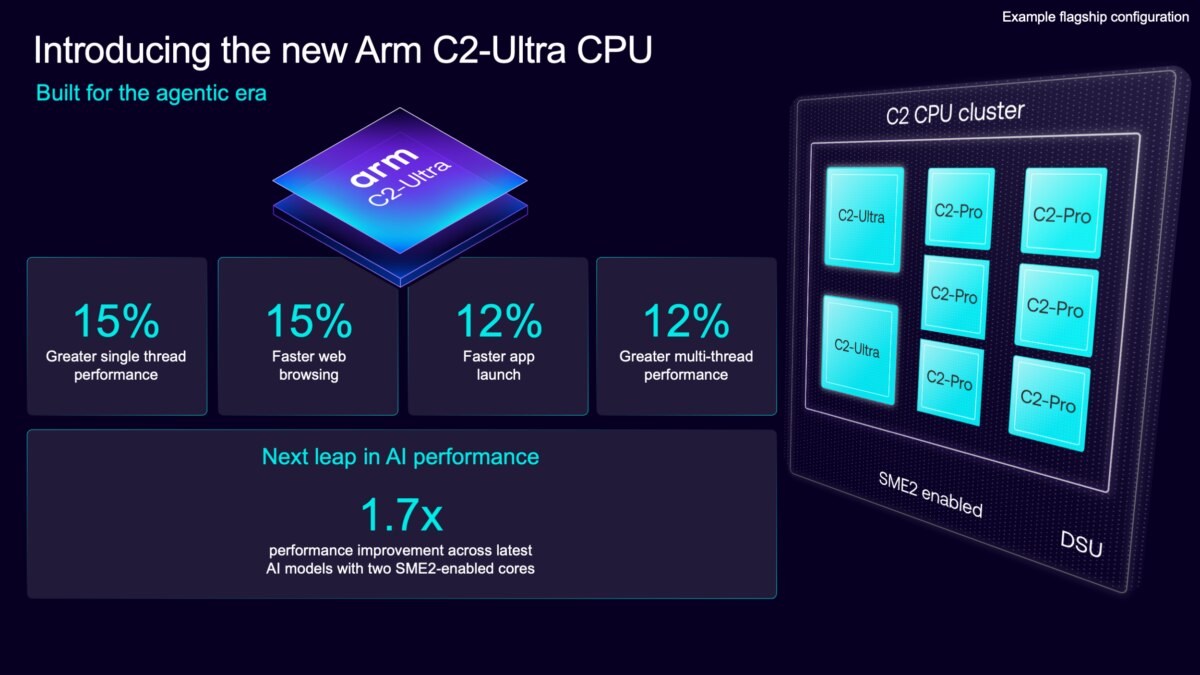
At the center of the new platform is the Arm C2 CPU Cluster, which includes the flagship C2-Ultra CPU alongside efficiency-focused C2-Pro cores. According to Arm, the new CPU architecture has been engineered to manage the next generation of AI applications known as agentic AI. Unlike traditional AI assistants that simply respond to commands, agentic AI systems are capable of understanding intent, maintaining context, planning actions, and coordinating tasks across multiple applications and services.
The company claims the C2-Ultra delivers up to 15 percent higher single-thread performance compared to its predecessor while achieving significantly better power efficiency.
The architecture also incorporates dual Scalable Matrix Extension 2 (SME2) units, enabling faster execution of AI workloads directly on the CPU. Arm states that AI-related tasks can experience performance improvements of up to 70 percent in selected scenarios, making devices more responsive when running language models, voice assistants, translation tools, and other AI-driven applications.
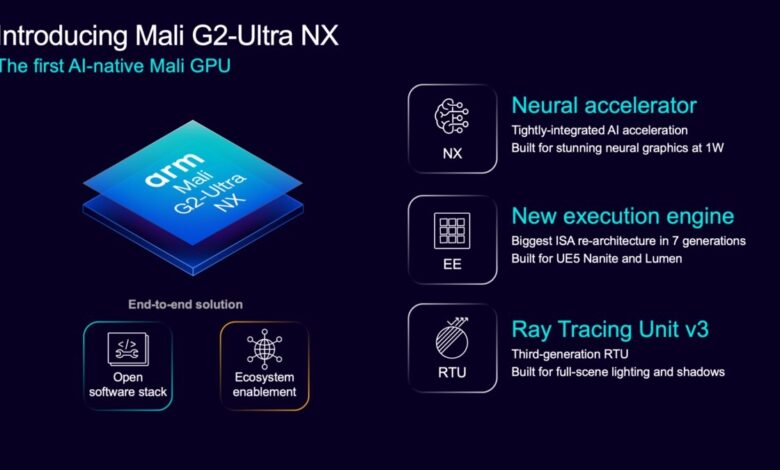
Perhaps the most notable announcement is the introduction of the Mali G2-Ultra NX GPU, which Arm describes as its most advanced mobile graphics processor to date. The new GPU integrates dedicated neural accelerators directly into the graphics pipeline, allowing AI-powered rendering techniques to become a core part of the gaming and visual experience.
This new approach enables what Arm calls neural graphics, where artificial intelligence assists with image reconstruction, frame generation, visual enhancement, and rendering optimization.
These capabilities are designed to deliver significantly improved graphics quality while maintaining the strict power and thermal limits required by modern smartphones. Arm claims the technology can achieve up to four times higher performance per watt for neural graphics workloads compared to traditional rendering methods.
Gaming is expected to be one of the biggest beneficiaries of this technology. Mobile titles will be able to deliver richer visuals, smoother frame rates, and more immersive environments without requiring excessive battery consumption. Arm has already begun collaborating with major game developers and engine providers to integrate its neural graphics technology into future gaming experiences. Several upcoming games are expected to showcase these advancements as developers embrace AI-assisted rendering techniques.
Beyond gaming, CSS for Mobile 2 has been designed to support a broad range of AI-powered applications. These include real-time language translation, multimodal AI systems that process voice, text, and images simultaneously, and next-generation mobile assistants capable of performing complex tasks with minimal user input. The platform’s architecture allows workloads to be intelligently distributed across CPUs, GPUs, AI accelerators, and cloud services, ensuring optimal performance and efficiency.
Another key aspect of the platform is its focus on helping semiconductor companies and device manufacturers accelerate development timelines. Arm has packaged CPUs, GPUs, system interconnects, software frameworks, and developer tools into a comprehensive platform that simplifies chip design while still allowing extensive customization. This approach is expected to help partners bring new AI-powered devices to market more quickly.
Industry analysts view the launch as part of a broader shift toward AI-native computing, where artificial intelligence is no longer treated as an optional feature but becomes a foundational component of the device experience.
As smartphones continue to evolve into intelligent personal assistants capable of understanding context and executing tasks autonomously, platforms like CSS for Mobile 2 could play a crucial role in shaping the future of mobile computing.

With the introduction of the C2-Ultra CPU, C2-Pro cores, and the Mali G2-Ultra NX GPU, Arm is positioning itself at the forefront of the AI-powered mobile revolution. The new platform demonstrates the company’s vision for a future where advanced AI capabilities, immersive graphics, and energy-efficient performance work together seamlessly to deliver smarter and more powerful mobile experiences.